Lemon Pickle Recipe – South Indian Style

எலுமிச்சம்பழம்  ஊறுகாய் 


Lemon pickle / Elumichampazham Oorukkai (Tamil) is a basic and  important condiment available  in all Indian kitchen.  Making pickles is an affordable and practical method of preserving lemons for a  long term usage. Ingredients and method of making pickles may vary from one home to other home. This is my mom’s recipe. This is the first time I made this pickle and the outcome was really tasty and more flavorful. I always prefer homemade pickles because they are less in sodium, no preservatives added and also cost effective. It goes well with yogurt rice . If you get lemons then you should try this recipe, it is not only tastes yummy, also it cools the body and fight against infections.Also check this recipe Mango Pickle.

Ingredients

  • 4 Lemons, Big
  • 1/2 Tsp of Turmeric Powder
  • 3-4 Tsp of Salt

To Temper

  • 5 Tbsp of Indian Sesame Oil / Gingelly Oil
  • 2 Tsp of Mustard Seeds
  • 1 Tsp of Urad Dal
  • 1/4 Tsp of Hing / Asafoetida
  • 4 Tsp of Red Chilly Powder or Cayenne Pepper
  • 1/2 Tsp of Fenugreek powder, Dry Roasted

Method

    • Wash and wipe the lemons with cloth /paper towel, there should not be any moisture on the lemons. Cut them into big pieces (1 lemon = 8 pieces) and remove the seeds.
    • In a bowl, mix the chopped lemons, turmeric powder and salt, with a spoon.
    • Put this mixed lemons in a clean, sterilized glass bottles, or ceramic bowl with a lid and leave it aside for 5 -7 days. During this period, place the glass bottle in hot sun for 1 hour daily, also stir the mixture daily to avoid fungal contamination because by this time, lemons would oozes out lot of juices, by dissolving the salt, changes color and the skin becomes so soft.
    • After 7 days, we need to add the tempering to the lemon mixture.
    • For that, heat a pan/skillet, dry roast 1/2 tsp of fenugreek until it changes color. Powder it in a spice grinder or mortar & pestle.
    • Heat oil in a pan /skillet, add mustard seeds, urad dal, asafoetida, after it splutter, add the lemon mixture and red chilly powder, mix well with the temperings and saut’e for 2 mins. Finally add the roasted fenugreek powder, mix well and turn off the stove. Let it cool down for 1 hour and then transfer this pickle to the glass jar.
    • Homemade Lemon pickle is ready to enjoy with curd (yogurt) rice or any upma or any variety rice dishes.


Tips

    • Adjust the amount of salt and red chilly powder according to your taste.
    • You can also use coarse kosher salt instead of using the normal fine salt.
    • More oil you add, the more the shelf life of the pickle.
    • You can also add roasted mustard seed powder along with roasted fenugreek powder for a different twist to the taste.


 Health Benefits of Lemon

    • Lemon being a citrus fruit, fights against infection.
    • Rich in antioxidants.
    • Lemon lowers blood pressure and increases the levels of HDL (good cholesterol) .
    • Lemon is found to be anti-carcinogenic.
    • Lemon juice is said to give a glow to the skin.


How to Boil Peanuts in Pressure Cooker


       Boiled peanuts are popular in places where peanuts are common. Fully mature peanuts do not make good quality boiled peanuts rather the  raw or green ones are used. Boiling the peanuts are very easy at home. You can cook raw peanuts in different ways like stockpot method or in pressure cooker or crock pot. I prefer pressure cooker method which makes my work easier. Cooking time vary greatly depending on how fresh the peanuts are. The fresher the peanuts, less time it takes to cook. You can make so many Indian recipes with peanuts like burfi, laddu, rice and chat. But I love to eat the fresh boiled peanuts for evening snack as it has no extra calories in it like no oil or sugar. Try this recipe at home and enjoy !!!!!!


     Ingredients

        3 cups of Raw, Fresh Peanuts
        5 cups of Water
        3.5 tsp of Salt
        Pressure Cooker

     Method

  • Wash and rinse the raw peanuts several times in water to remove the dirt and debris.
  •  Soak the washed raw peanuts in a big bowl of water for 2 hrs or overnight. Again, wash it in cold water.
  • After that, add the soaked, washed peanuts to a pressure cooker.
  • Add salt and enough water to a pressure cooker containing peanuts.
  • Now close the lid of pressure cooker, turn on the flame and wait for 2 whistles and then simmer it for 45 mins. Turn off the flame and let the pressure release on its own.
  • Pour the cooked peanuts to a colander and drain the water. Cool for few mins.
  • Break open the fresh peanuts and enjoy the tasty boiled peanuts.


     Tips

  • You can cook the peanuts either in pressure cooker or stockpot or crock pot.
  • Adjust the amount of salt according to your taste.
  • You can store boiled peanuts in refrigerator for 2-3 days. Store it in a airtight container and enjoy cold peanuts.

     Health Benefits of Peanuts

  • Rich in energy.
  • Good source of monounsaturated fat, niacin, folate, vitamin E and anti-oxidants.
  • Prevent gall stones  and good for heart.
  • Good source of resveratrol which reduces the risk of stroke.    


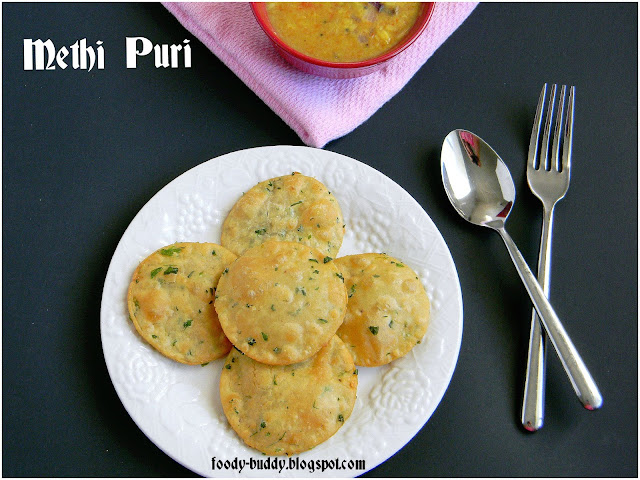
Mini Methi Poori / Methi Puri Recipe – Indian Breakfast Dish


            Puri / Poori is a deep fried puffed bread, generally made with wheat or maida, salt and water. Additionally, in this recipe, I used  fresh fenugreek leaves (methi) from my garden. Here the dough is then kneaded, rolled out into a circle and then deep fried in a hot oil. It tastes great if eaten hot, puffed up with a crispy outside and a moist inside. Though it starts to lose its puffiness and becomes chewy, when cold, poori is still tasty when eaten that way . It is often served for weekend breakfast. Good accompaniment for poori is potato based curries, dal and channa masala. 


     Ingredients

           1/2 Cup of Whole Wheat Flour
           1/2 Cup of Maida / All Purpose Flour
           1/2 Cup of Methi/ Fresh Fenugreek Leaves, chopped
           1/4 Tsp of Ajwain / Omam
           1/4 Cup of Milk
           2 Tbsp of Oil
           2 -3 Tbsp of Water
           Salt to taste
           3 Cups of Vegetable Oil for Deep Frying


     Method


  • In a medium size bowl, combine the whole wheat flour, maida, ajwain, chopped methi leaves and salt. Add oil and milk, mix by hand until all ingredients are well combined. Gradually add water, to form a dough that holds together.
  • Knead the dough in the bowl until the dough is smooth about 5 mins. The dough should be moderately stiff. 
  • Cover the bowl with a kitchen towel and set aside for 15 mins. In a clean counter top, roll the dough into a rope and divide it into 12 – 14 equal portions. 
  • Roll each portion into a ball. Flatten the balls with a rolling pin and roll into a circles ( Small or big) about 1/4 inch thickness.
  • Heat the oil in a heavy bottomed pan over medium heat until it reaches 350 degree F.
  • Test for readiness by placing a small piece of dough into the hot oil. If the bubbles rises to the surface immediately, it is ready. Place the circles into the hot oil, one piece at a time. The dough will sink to the bottom, but immediately rises up.
  • Use light pressure with the back of slotted spoon to submerge the dough until it puffs up. Then, turn it over to brown on second side. 
  • Once it is done, remove the poori with a slotted spoon and drain on paper towel. Repeat the same procedure with the remaining dough. Serve immediately or keep it warm until ready to serve.


    Tips

  • If you find your dough is sticky, add a tbsp of flour and knead it again.
  • Always cook poori in a medium heat.
  • If the oil is too hot, the poori will brown too fast, may remain doughy and uncooked inside.
  • You can add grated ginger, red chilly powder for a different twist to the taste.


    Health Benefits of Methi or Fenugreek Leaves

  • Lowering Diabetes I and II
  • High in dietary fiber and Vitamin C
  • Lowers serum cholesterol.
  • Improves digestion.
  • Fenugreek leaves are rich in vitamins, minerals and good source of protein and Iron.